Pages

Friday, July 11, 2014

Harps

http://upload.wikimedia.org/wikipedia/commons/1/11/Cross_harp.JPG
I believe we should all just come
to accept that my addition of visual content
is always going to be pretty subpar. Hooray,
at least, for wikipedia and morguefile, or
you'd have no pics at all.
It turns out that in one of my many false starts (and middles and ends) for Unsightly (AKA Eye of the Beholder AKA Sight Unseen AKA Beheld AKA Oh-How-I-Hate-Titles), Isabel suddenly developed a desire to play the harp—and absolutely no aptitude for it. Really it became quite a large part of the book for a while until I suddenly found myself thinking, “There is no point to this.” Okay, it wasn’t strictly true. There was sort of a point. It was this whole way of showing that Isabel wasn’t very good at sticking to things, gave up when the going got hard, blah blah blah. But in the final analysis, it was just sort of flat.

However, tragically, I had already written a number of scenes (oh my gosh! the endless numbers of words that I cut from this story! I wrote at least 150K for my 72K novel; argh!) involving the harp.

And I liked at least one of them (originally I liked three, but time will kill delusions of grandeur, and now, a year later, I only like one). So what’s a girl to do with a scene about a harp that never made it to the finished product? Post it on her blog, of course!


 “What shall it be tonight, Isabel?” he asked one evening as we were settling into the library. “A story? Or will you finally play your harp for me?”
“I have not been practicing as I ought,” I told him. “Perhaps next week. I’m sure by then . . . ”
“Your excuses will not work on me tonight. What better time to practice than now? Come, I insist. You have put it off too long and I am nearly expiring from curiosity.”
“I suppose I cannot avoid it forever,” I told him. “But please recall that you were warned.”
I had long since moved my harp from the parlor and its cold formality to the gentle comfort of the library. Now all I had to do was rise and move to the opposite end of the room. As I rose, I attempted to sneak a glance into the shadows. The Beast, as usual, was invisible, seeming to draw even farther into the dark when I looked his way. I sighed. My recent increased efforts to see his face had returned me nothing but frustration.
For the umpteenth time I put it from my mind. Sometimes I felt that’s all I ever did—put from my mind the things I cared about most. But that was my way. So ignoring the mystery again, I sat at the harp and began to play.
I liked the idea of being able to play a harp just as much as I used to. It was such a graceful instrument. But I didn’t seem to have the coordination for it—or the desire to practice. I did not look forward to the embarrassment I was going to suffer tonight.
“Why don’t we wait one more day?” I pleaded. “You sound very tired. I’m sure you need to get to bed.”
“Oh no,” he said with a chuckle. “You are not going to get out of it so easily.”
I sighed my best long-suffering sigh and began to play. It was a beautiful instrument, I had to admit. Graceful and sweet, sound pouring out of it like the songs of birds.
If those birds had no sense of tune and were suffering under torture.
A few moments of almost-music passed and when I stopped and looked down, the Beast applauded politely. I thought I could detect, even in his clap, a hint of amusement.
I began to play again, this time with a bit more gusto. “That, in case you are wondering,” I told him as I played, “was the sound of a flight of angels taking off toward heaven.” Discordant noises floated in the air. “You should by no means mistake it for a herd of hippopotami trudging across shards of broken glass.”
The snort from across the room was loud. It really was a rather apt description. “Of course I had not imagined it anything other than a flight of angels.” Then a pause as I hit more incorrect notes. “And I believe that was the sound of the angels crashing into a tableful of goblets.” He sighed gustily. “Ah, such lovely music.”
“Yes,” I agreed. “I do have a rare talent for it.”

Wednesday, July 2, 2014

Small Things

This is a rough draft of a longer piece I started working on a while ago, which may or may not go anywhere. One way or another, I thought I'd share. I think it's nice to sometimes think about the less shiny moments that people have as well as their perfect ones.


Ankita watched the little boy as he sat on the ground, staring intently at something she couldn’t see. His hands were dusty and his feet caked with the dirt beneath him. She thought she could see smudges on his nose and forehead as well.

She looked up at her father, a question on her face.

He shrugged and smiled. “What exactly did you expect? He’s not yet two.”

Her gaze went back to the little boy, who was now crawling on his hands and knees, apparently following the course of some small creature as it swerved back and forth.

Something a little more majestic, she thought. Something that proclaimed him special. Something like the star they had seen in the sky, the one that had brought them here in the first place. Not grubby little fingers and dirty cheeks.

But they were here, and they would deliver her father’s gift no matter what she thought. So after their pause to watch the boy for a moment, Ankita and her father approached the little house in the middle of town. The rest of the men followed behind.

“Hello,” her father called.

The child looked up and smiled, a toothy grin. He waved a chubby hand then ran from the yard into his house. A moment later, a woman emerged, wiping her hands on a rag. She looked up. “Yes?”

Ankita’s father stepped forward, the designated spokesman for the group, and Ankita trailed behind. The woman smiled at them both politely and waited.

Her father held up his package. The others did the same. “We come bearing gifts for a king.”

Ankita stood back, suddenly uncertain of her role in all this. It had seemed so vast and important when she begged him to take her with him; he would be going to see the king of the Jews! How could she not go too? Now, though, she felt foolish. She had not brought any gifts; her father was rich but she just a child, just some more baggage.

Lost in her thoughts, she didn’t hear the woman’s response to the riches they brought. But Ankita couldn’t help but notice how unsuited their gifts were for such a life as she saw before her. What would a carpenter and his wife have to do with rich spices and scents and gold? They probably didn’t even know where to sell such things.

Still, the woman accepted the vessels graciously. They were more than she could carry, so she invited the men inside. Ankita had been temporarily forgotten, and she moved back even farther, beside their pack animals, waiting to be remembered and invited in.

Movement out of the corner of her eye caught her attention, and she turned to look. Around the side of the house, the little boy peeked out at her. He pulled back quickly when she looked toward him, so she barely caught a glimpse of dark hair before it disappeared. A tiny giggle sounded from around the corner.

Oh, she knew this game. She could play too. So she deliberately turned around, her back to the house, but she kept the corner just within her sight. When the dark head peeped out again, she zipped around to catch him with her gaze. But he was gone again, too quick for her. The giggle was louder now.

She turned again, and the game proceeded for several minutes until finally she pounced forward and went rushing around the house. The boy shrieked delightedly and ran from her. But his pudgy toddler legs were no match for hers, and she caught up with him in only a few steps, pulling him to the ground and tickling him. He retaliated by tugging on her long braid. Soon they were both rolling on the sandy ground, laughter bursting out of them.

“Ankita?” her father called. She whooshed to sitting, looking down at herself. Oh, she had spoiled the lovely clothes he’d let her wear especially for this day.

He came around the corner of the house then stopped short when he saw her. “All is well?” He raised his brow, a glint of humor in his eyes.

She nodded, feeling sheepish and far too young. Standing, she brushed off her dress as best she could, avoiding looking again at the little boy who had made her forget that she was supposed to be too old for such games.

For the rest of the visit, she pretended not to see him. She sat still and silent as the adults broke bread. She listened intently as they spoke of prophecies and warnings. She followed her father out to the animals again, their stay already over, their journey stretching out far before them.

But just as she turned to mount, there was the little boy, standing behind her, tugging on her dress.

“Present,” he said in a voice that still couldn’t pronounce all the consonants. He held out an object, which he dropped into her hand. “Thank you.”

It was a rock, small and round and cool in her hand. A small thing, she thought, looking down at it. Like the manna from the story they’d told her or like the words of the prophet Zechariah.

She looked then at the small boy before her. For a moment, she imagined him grown, strong, powerful. In his grin, she caught a hint of who he might be ten, twenty, thirty years from now.

In his eyes, she saw reflected who she might be as well. 

She smiled back, her fingers wrapping around this treasure.

Monday, April 21, 2014

Writing Process Linky Party!


Here I am, one in a long line of blog links talking about our writing process. I was invited by Heather Romito, who is a friend of the lovely Katy White, another MMW blogger. Go check out their blogs and keep clicking back if you want to keep discovering more cool writers!


What am I working on? 

My current project is titled (for now) The Price of Sight. It’s a loose sequel to Unsightly, a young adult retelling of “Beauty and the Beast.” It follows the daughter of Isabel (the Beauty) and the Beast. When she comes into some very dangerous and unwanted magical power, she does everything she can to deny it. But when she realizes that she and her loved ones are in danger from someone who seeks to control her power, she has to overcome her fear and learn to control her magic.

It’s part adventure, part coming-of-age, and part court intrigue, with the tiniest whiff of romance.

I also discovered that I like a break from the longer projects, so I’ve been doing more flash fiction lately, just for kicks, most of which I post here on my blog.


How does my work differ from others of its genre?

I love the stories behind the stories. Some fairy tale writers like to take just a little bit or hint of the original story and take off from there, expanding into a completely different tale. I have loved many of these stories, so I can’t complain. But I love looking at the questions that arise from the stories—Why would she do that? Would that really work? Then I try to figure out what pieces of the story are “missing” from the original and would suddenly make those events make sense. (For example, in the original “Beauty and the “Beast,” I was always bothered by the fact that she fell in love with her jailer. Can we say Stockholm syndrome? So in my retelling, I addressed that.)

I also like to think that one difference is the way I deal with magic. Most YA fantasy that I run across has a rather nebulous sense of what is and isn’t possible with magic in that world. That works fine in many cases, but I have always thought that magic, like science, has rules—even when you don’t understand them. The magic in my novels is rule-bound, which I think makes for a harder and more real world for my characters to live in, especially because they tend not to understand the rules.


Why do I write what I do?

Young adult fiction has always drawn me because I think that generally speaking it has a hope that isn’t always present in adult novels. YA can still be dark and painful, but most YA novels seem to say that things can get better. I love fantasy because, even though I don’t believe in actual magic, I do believe that the world can be a magical sort of place (I mean, have you seen fireflies?). So these are the genres that appeal most to me right now.

I also love retelling fairy tales because I think there’s something so wonderfully timeless about them. The themes and ideas just apply all over the place, and I think they endure because they appeal to our inner selves and have things for us to learn—but without having to be beat over the head by “the moral to the story.” They’re just good stories, but with meaning. (I wrote a whole honors thesis on this subject and the story of “Beauty and the Beast,” so just be grateful I gave you the one-paragraph version.)

Oh, plus, I think fairy tales are pretty. :)


How does my writing process work?

If I could tell you that, I bet I’d be getting a lot more done than I currently am. With Unsightly, I muddled through and found myself very frustrated a number of times when suddenly there were massive gaps in the plot and I couldn’t figure out how to fix them. When I was finally doing the first major rewrite, I discovered that when I outlined scenes and determined their purposes and the main actions in them, those scenes went so much better. So for the current project, I’m trying a new thing: I’m outlining much more extensively than I did for Unsightly, hoping that will help me cut back on some (not all, of course) of the frustration. We’ll see how it goes!

Next up in this fun blog linky thing is going to be FrankAdams, a funny guy who writes humor and horror together (because what’s funnier than absolute terror?). (I may also find another friend to link to and insert him/her here.)

Wednesday, April 9, 2014

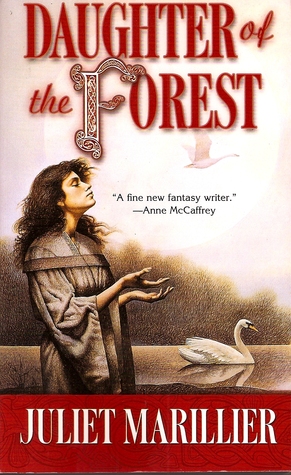
Book Review: Juliet Marillier's Daughter of the Forest


Daughter of the Forest  (Sevenwaters, #1)

Rating: 4/5 stars (maybe even 4.5)

Clean rating: PG-13. There is discussion of violence but not particularly gore, and in my opinion the violence was not really a problem. There is also some torture, and you see the after-effects, not the torture itself. But that’s kind of rough anyway. The worst is that there is rape, and while it is not described in gory detail, it is emotional and ugly and horrific (not much of a shocker, considering that it’s rape). So the content is emotionally fraught, but I didn’t find it to be morally ugly, if that makes sense. There was no glory in the terrible things that happen in this book; there was a very strong awareness of the ugliness—which, in my opinion, makes it a much stronger book.

Short summary: Sorcha is the youngest of seven children. When their father marries a sorceress, Sorcha and her brothers try to protect themselves from her. They fail and end up with a terrible spell placed on them that only Sorcha can undo, but only at great personal cost. The book is an extended version of “The Six Swans,” set in medieval Erin (this is Ireland, right? my history knowledge is sooo very bad).

What I liked: It would probably be a shorter post if I just skipped straight to what I didn’t like. Because pretty much I liked everything.

For starters, the tone and voice and language. It is beautifully written. The words are fluid like water rushing past and so easy to read. This is not flowery, overblown language. It is simply the loveliness of gorgeous, perfect prose. It is a beauty that I often try to achieve in my stories and that Marillier does in a way that makes it look effortless. Okay, enough gushing. It’s wonderful, that’s all I can say.

Next: I have read versions of “The Twelve Dancing Princesses” where, at the end, I could not keep any of the princesses straight. I recently read a book that had only four siblings, and I’m still not sure I could name a single one of them. But in this novel, it’s been a week or so since I read it, and I’m pretty sure I can not only name each of the six brothers, but I can also tell you a little bit about each one.* They all stood out as separate people, which I think is a difficult task in cases like this. But Marillier did a good job with it.

Sorcha was a likeable character. She had a lot of ugliness to deal with, but she loved her family and she was hardworking and she was overall pretty darn awesome.

What didn’t work for me: Well, we’ve got to come up with something here, right? So I will say that it was long. Not only is it over 500 pages, but the print is really small. This is undoubtedly a turn-off for some, and I confess I wasn’t thrilled about it. But it didn’t really feel long to me. As in, “Really? It’s not over yet?” I’m sure I could come up with something else to complain about, but they would be minor quibbles.

Last words: It’s a good thing I read this because I had once considered doing a novel-length retelling of “The Six Swans” (there’s something about this tale that I just love), but now I can honestly say that the best possible version of this story is already written. I might someday revisit it just for fun, but I would have to place it in a contemporary setting and with a very different emotional tone and just a wildly different story overall because this version is pretty much perfect. If you like fairy tale retellings with a sort of lush magical tone, you must read this!

* Okay, now I have to test myself. Mild spoilers contained herein. Liam: leader, oldest, warlike. Diarmid: idiot, hothead. Cormack: Conor’s twin, a little warlike, loved his dog. Conor: druid. Finbar: moody, into justice. Padriac: loved animals, a healer. Wow, look at that! Easy peasy.
** P.S. I liked this one a lot better than Wildwood Dancing, even though I also liked that one.